Graphics card removal and installation
Tools required: Philips head screwdriver.
WARNING Before handling any internal components of your PC, ensure the PC is off & disconnected from wall power.
NEVER open the power supply unit; internal capacitors may hold hazardous levels of charge long after power is disconnected.
NEVER attempt to handle or move internal components while the PC is running.
Tip: Laying the PC down flat on its side on a clean surface is the easiest and safest way to work inside your PC to prevent components from slipping or falling.
Identifying Your GPU power cable type
Modern graphics cards generally use one of two power connector standards:
- Traditional PCIe power connector(s): 6-pin / 8-pin / 6+2 pin
- Found on most AMD Radeon graphics cards, older Nvidia GeForce cards (GTX / RTX 20 & 30 series), and lower-power GPUs
- Features a small top latch/clip. Uses 6-pin or 8-pin connectors (often split into 6+2 pins)
- 16-Pin power connector(s): 12VHPWR / 12V-2x6
- Found on Nvidia GeForce cards (RTX 40-series and newer high-power GPUs), a few AMD Radeon graphics cards, and Nvidia's high-end professional workstaion GPUs
- A single compact connector featuring 12 power pins and 4 small "sense" pins on top
Removing a graphics card
- Disconnect from wall power: Ensure the PC is powered down and the main power switch on the back of the PSU is turned OFF (O) before unplugging the power cord from the PSU.
- Remove the side panel: Remove your PC's side panel to access the graphics card in the motherboard's top PCI-Express x16 slot.
Depending on your case brand & model, removing the side panel can be done in a number of ways.
It may be clipped in; only needing some firm pressure to pull it off, or you may need to remove the top panel before the side is removable, or you may need to undo some screws at the rear that hold the side panel on, or even that it's just magnetically held in place, or on a door-hinge style setup.
You can refer to your case's online user manual for more tips, or contact us with your Evatech order details for assistance. - Disconnect the power cable(s):
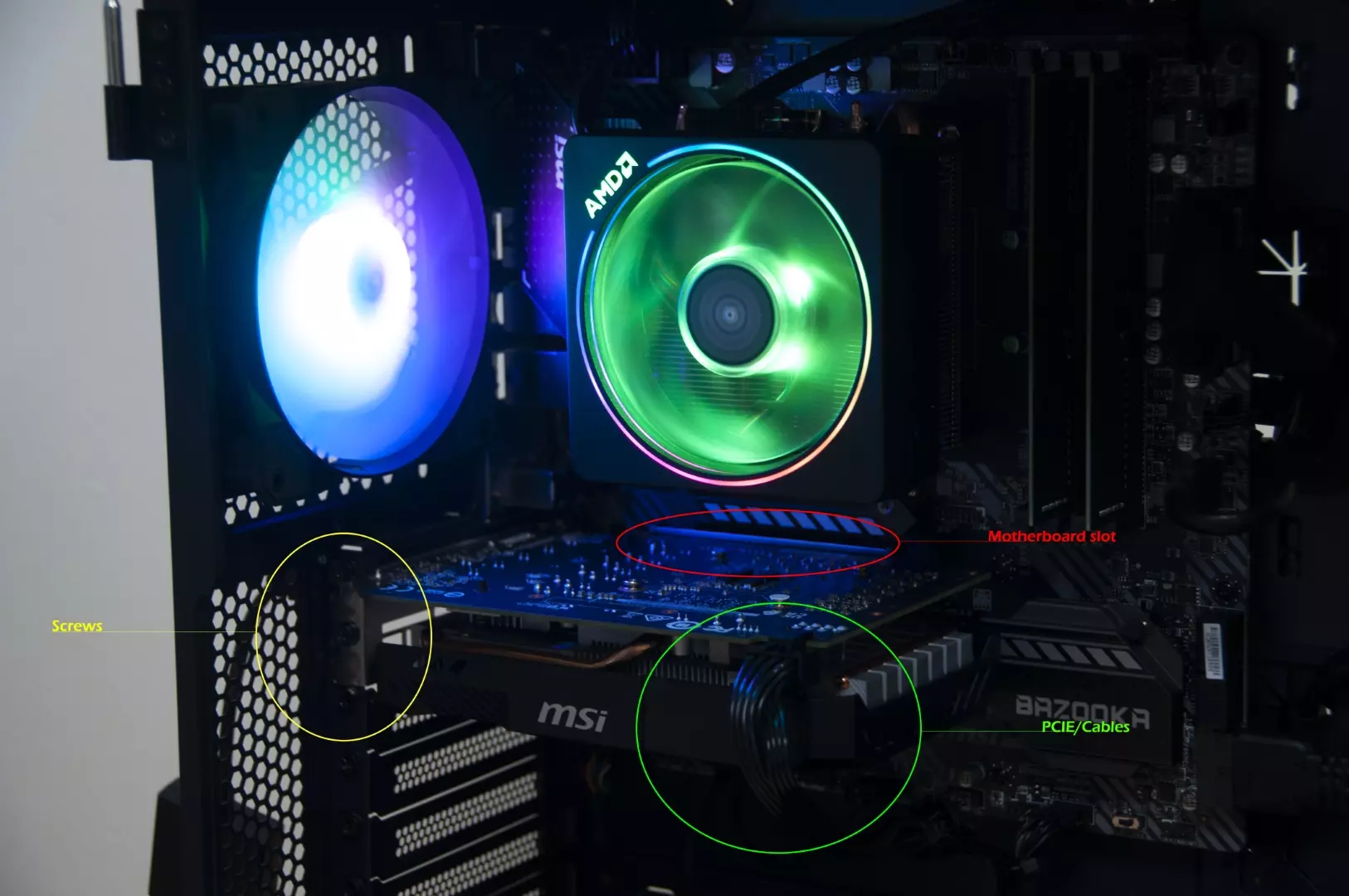
- For traditional PCIe connectors (6/8-pin): Firmly press down on the top plastic release latch and pull the connector straight out. Repeat for any additional power cables
- For 16-Pin connectors (12VHPWR / 12V-2x6): Squeeze the top release clip on the connector and pull straight back out of the GPU socket. Avoid tugging on individual wires
- Remove GPU case screws: Using a Phillips head screwdriver, remove the 1 to 3 retention screws securing the metal bracket of the GPU to the back expansion slots of the PC case.
Do not remove any of the screws that are part of the GPU's assembly. - Release the PCIe slot latch: Press down on the plastic retaining clip at the right-hand end of the motherboard's PCI-Express slot (closest to the motherboard surface) to unlock the card.
Some motherboards may have a slight alternative to the simple clip, but it should be quite clearly marked on the motherboard if there's any deviation. - Lift out the GPU: Carefully pull the graphics card straight up and out of the slot.
Installing a graphics card
- Align & seat the card: Ensuring the motherboard's PCIe retention clip is in the open position first, carefully align the gold PCIe connector of the graphics card with the motherboard's top PCI-Express x16 slot. Push firmly straight down until you hear or feel the motherboard's retention clip automatically click into place.
- Secure the GPU to the case: Re-insert and tighten the Phillips head screws to fix the GPU's rear metal bracket securely to the PC case chassis.
- Connect power cable(s):
- For traditional PCIe connectors (6/8-pin)
- Plug in the required 6-pin or 8-pin PCIe cables until the latch securely clicks over the connector tab
- If your PSU supports it: Use separate individual PCIe power cables directly from your power supply rather than daisy-chaining multiple plugs off a single cable. If your PSU doesn't support it, daisy-chaining isn't inherently a problem! Just best practice when possible.
- For 16-Pin connectors (12VHPWR / 12V-2x6)
- Align the connector carefully and press firmly until it is completely flush with the socket.
- [CRITICAL SAFETY NOTE]
- Ensure there is zero gap visible between the plug and the GPU power socket. You should hear/feel a distinct click. Partial insertion can lead to uneven current delivery and thermal damage.
- Cable bending clearance: Maintain at least 35mm of straight, unbent cable extending from the connector head before allowing the cable to bend around your side panel or glass. Avoid sharp or forced bends near the plug.
- Power adapters (if using multi-8-pin dongles): Ensure all 8-pin PCIe cables are firmly connected into the adapter dongle inputs before plugging the 16-pin connector into the card.
- For traditional PCIe connectors (6/8-pin)
- Final check: Ensure no loose cables are obstructing fan blades. Re-attach your PC side panel, reconnect external monitor display cables to the graphics card outputs, and reattach wall power, and don't forget to flip the PSU switch back on!
Need further visual guidance?
If you prefer a step-by-step video demonstration on graphics card installation and proper cable management; watch Linus Tech Tips GPU installation tutorial on YouTube:


 6 Mediterranean Circuit, 3173 VIC
 Monday - Friday 10am-6pm
 +61 (03) 9020 7017
 ABN 83162049596
 Evatech Pty Ltd